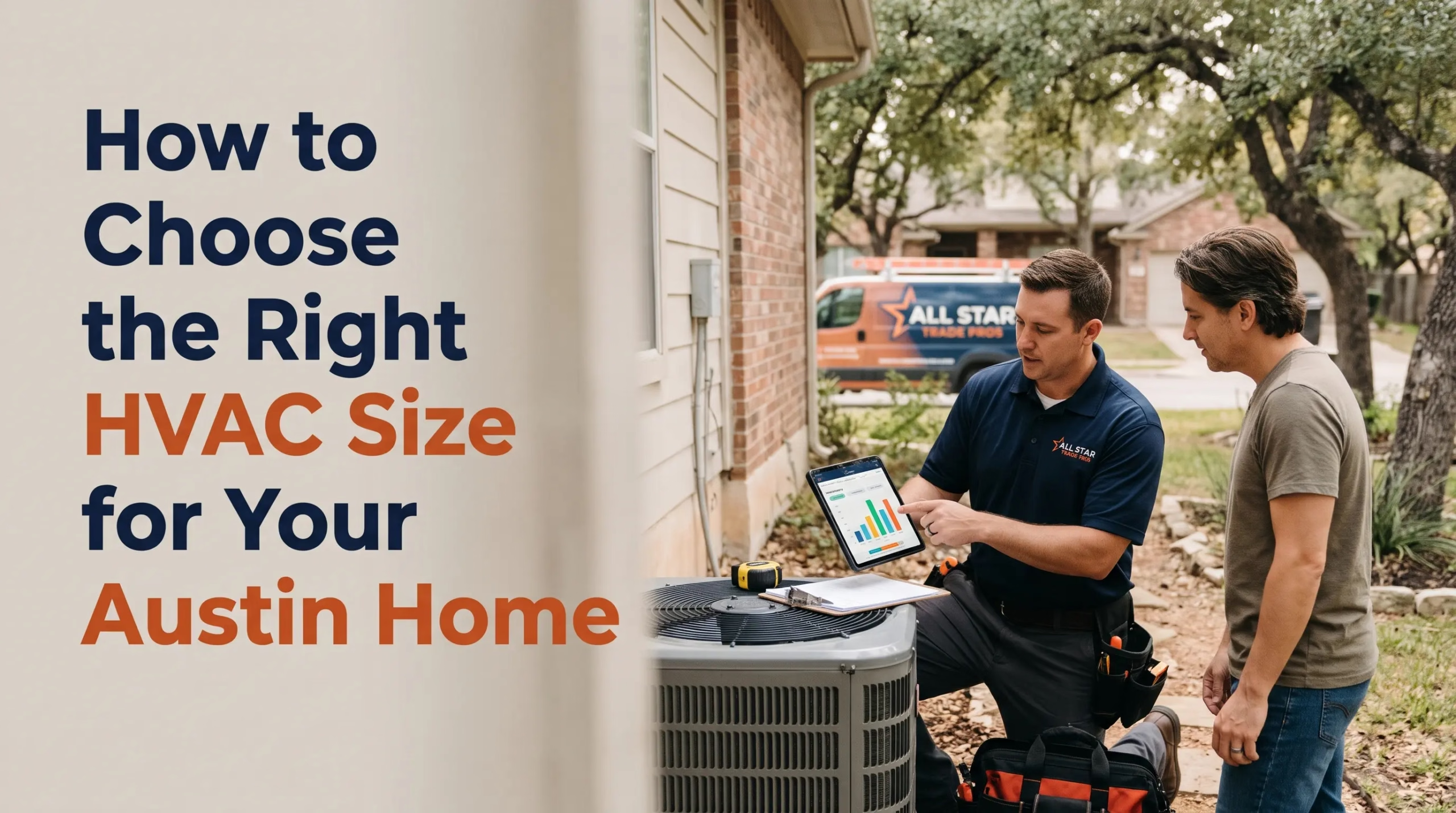
The right HVAC size for an Austin home comes from a Manual J load calculation, not from square footage alone. As a rough starting point, many Central Texas homes need about 1 ton of cooling for every 500 to 600 square feet. That puts a 2,000-square-foot house somewhere between 3 and 4 tons. But insulation, windows, sun exposure and ductwork can push that number up or down by a full ton. A proper calculation is the only way to know for sure.
Below, you’ll find a quick sizing estimate, what an online HVAC size calculator can and can’t tell you, and the questions to ask before you sign a quote.
What “Tons” Mean in HVAC Sizing
In HVAC, a ton measures cooling power, not weight. One ton equals 12,000 BTUs of heat removed per hour. Home systems usually come in half-ton steps from 1.5 to 5 tons.
Five tons is about the limit for a single home condenser. Larger homes and two-story homes in Austin often use two smaller systems, one for each floor. This setup also makes it easier to keep both floors comfortable.
Quick HVAC Size Estimate for Austin Homes
Use this table to check if a quote looks reasonable. Don’t use it to choose a system.
| Home size (sq ft) | Typical HVAC tonnage in Austin |
|---|---|
| 1,000 to 1,200 | 2 to 2.5 tons |
| 1,300 to 1,600 | 2.5 to 3 tons |
| 1,700 to 2,000 | 3 to 4 tons |
| 2,100 to 2,500 | 3.5 to 5 tons |
| 2,600 to 3,000 | 4.5 to 6 tons, usually split into two systems |
A newer home with good attic insulation and low-E windows often lands at the low end of its range, or even below it. An older home with single-pane glass, west-facing windows and leaky attic ducts can land at the high end.
Why Online HVAC Size Calculators Fall Short
Most online calculators ask for your square footage and ZIP code. That isn’t enough information. Two Austin homes of the same size can need very different systems because of:
- Attic insulation: how much heat gets in through the ceiling
- Windows: their size, type and direction. West-facing glass gets the full afternoon sun.
- Air leaks: gaps around doors, attic hatches and recessed lights
- Ductwork: Most Austin ducts run through attics that get much hotter than the air outside. Leaky ducts lose cool air before it reaches a room.
- Shade and roof color: Big trees or a light-colored roof lower the load.
- People and appliances: A busy household adds heat.
An online calculator can help you set expectations. It shouldn’t decide which size you buy.
How a Manual J Load Calculation Works
Manual J is the industry method for figuring out how much heating and cooling a house needs. It comes from the Air Conditioning Contractors of America (ACCA), and it isn’t optional. Section M1401.3 of the International Residential Code requires equipment to be sized with ACCA Manual S, based on loads calculated with Manual J or another approved method.
A technician measures the house room by room. They enter details about the walls, windows, insulation, ducts and the direction the house faces. The software then calculates how much heat the home gains on a hot “design day.”
That design day isn’t the hottest day on record. It’s a temperature the area goes above only about 1% of the hours in a year. For Travis County, ENERGY STAR sets the cooling design temperature limit at 98°F. So a system that’s the right size will run almost nonstop on a 104°F August afternoon. That’s normal and expected.
Once the technician knows the load, they use Manual S to pick equipment that matches it and Manual D to size the ducts.
Why Bigger Isn’t Better in Texas
Many homeowners think an extra half ton is cheap protection against Austin heat. It usually backfires.
Oversizing is common. Research from Building Science Corporation found that contractors often oversize systems to save time on load calculations and avoid callbacks. Here’s what that costs you:
- Poor humidity control. An AC only removes moisture when it runs long enough. A U.S. Department of Energy fact sheet notes that short cycling in humid climates leads to poor humidity control. The house reaches 74°F but still feels clammy.
- More wear. Frequent starts and stops are hard on the compressor.
- Uneven rooms. Short runs don’t move air through the whole house.
- Higher upfront cost. Bigger equipment costs more, and it may need larger ducts.
Manual S only allows a small margin above the calculated cooling load, usually about 115% to 125%.
An undersized system has the opposite problem. It runs all day, can’t hold the thermostat setting on hot afternoons and drives up power bills. This often happens when a home addition or garage conversion gets tied into the existing system.
Signs Your Current System Is the Wrong Size
It may be oversized if:
- It turns on and off every few minutes
- The house feels sticky even when it’s cool
- The temperature swings up and down during the day
It may be undersized if:
- It can’t reach the thermostat setting even on normal summer days in the mid-90s
- It runs all day and all night
- Rooms far from the unit stay warm
Refrigerant leaks, dirty coils and duct problems can cause these same symptoms, so rule those out first. Our guide on why your AC is not cooling covers the most common causes.
What Can Change the Size You Need
Your home’s cooling load isn’t fixed. Some upgrades lower it before you buy new equipment:
- Adding attic insulation
- Sealing leaky ducts
- Adding shade, solar screens or window film on west-facing glass
Make these upgrades first, then run the load calculation. You may end up with a smaller, cheaper system that works better.
The type of equipment matters too. Two-stage and variable-speed systems run at lower power most of the time, which helps with Austin humidity. They still need to be sized correctly.
If you’re cooling an addition, a converted garage or an upstairs bonus room, a ductless mini split is often a better choice than upsizing the whole central system.
Questions to Ask Your HVAC Contractor
Before you sign a quote, ask:
- Will you do a room-by-room Manual J calculation and give me a copy?
- What outdoor and indoor design temperatures did you use?
- Did you check my duct sizes and leakage?
- Why this tonnage and not half a ton smaller?
Watch out for a quote based only on the size of your old unit. If the old system was oversized, a matching replacement repeats the same mistake for another 15 years.
The Bottom Line
Square-footage charts and online HVAC size calculators give you a starting range. In Austin, the right tonnage depends on your insulation, windows, ducts and sun exposure. A Manual J calculation gives you the exact answer, and the right size is what keeps your house both cool and dry through a Texas summer.
Planning a replacement? See our guide to new HVAC system cost in Austin, TX, learn about our AC installation process or book a sizing visit online.