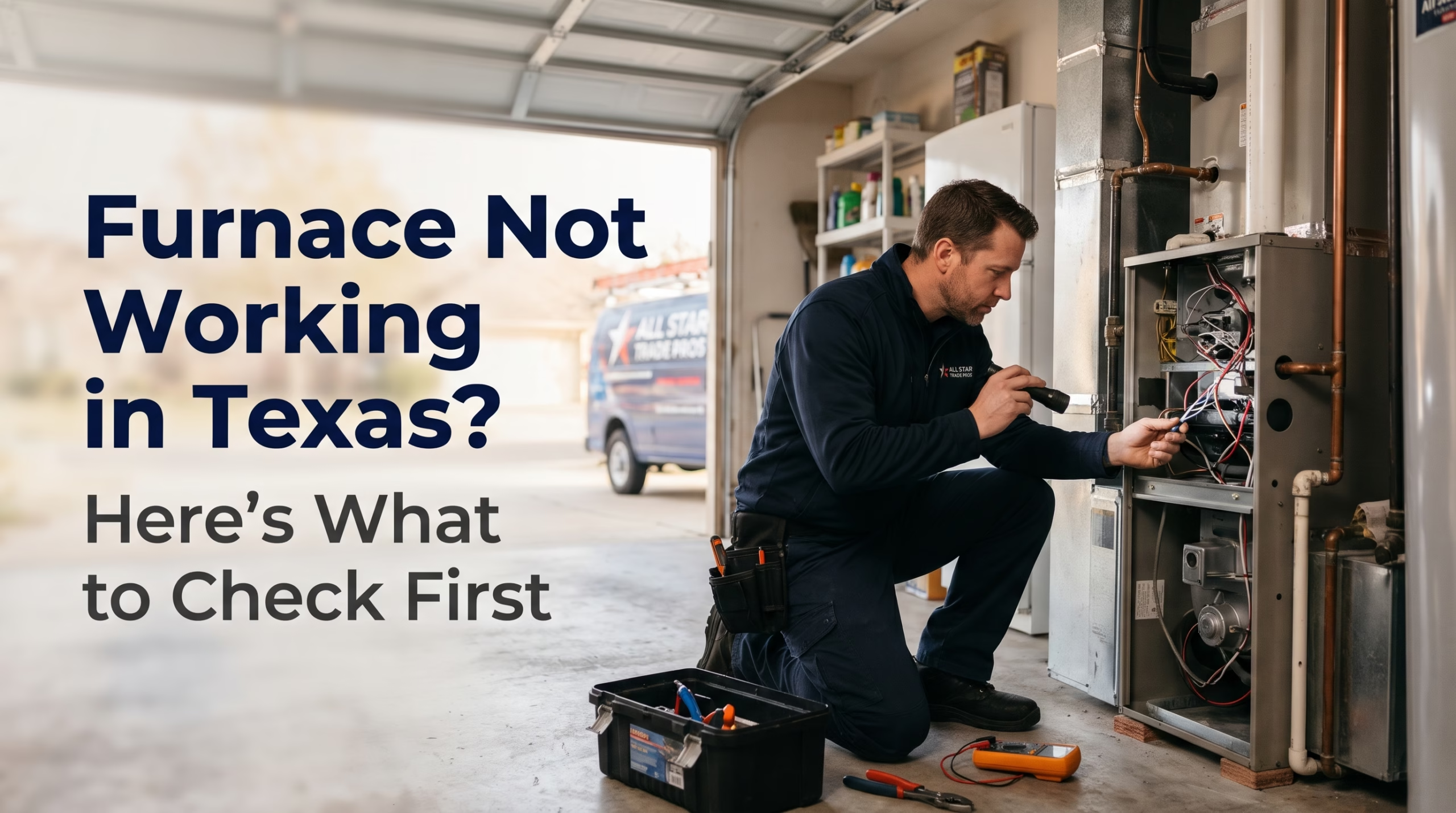
If your furnace is not working in Texas, start with the easy stuff. Check the thermostat, the circuit breaker, and the air filter. Then make sure the gas is on. These quick checks fix a lot of no-heat calls. But if you smell gas, hear a carbon monoxide alarm, or the furnace shuts off again after one reset, stop. Call a licensed HVAC technician.
Texas winters are short. Your heater sits idle for months, then has to work hard on the first real cold snap. That’s when worn parts give out. This guide shows what to check, in what order, and when to hand it off to a pro.
Safety First: When to Stop Troubleshooting
Know these limits before you touch anything.
- You smell gas or a rotten-egg odor. Leave the house right away. Don’t flip any switches. Call your gas utility or 911 from outside.
- A carbon monoxide (CO) alarm sounds. Get everyone into fresh air and call 911. CO has no color and no smell. The CDC lists headache, dizziness, and nausea among the warning signs.
- The burner flame is any color other than blue. Yellow, orange, or flickering flames point to a combustion problem. Call a professional.
- The furnace locks out again after one reset. Repeated lockouts usually mean a safety issue, not a fluke.
Never bypass or tape over a safety switch or sensor. They’re there to protect your home.
The CO risk is real. The CDC estimates about 500 people die each year in the U.S. from unintentional CO poisoning, and it lists gas-powered furnaces among the sources. Winter is the worst season. In CDC data from 1999 to 2004, January averaged about 2 CO deaths a day, compared to about 0.67 a day in July and August.
If you don’t have CO alarms, put one on each level and near the bedrooms. They’re cheap, and they matter most on cold nights when the heat is on and the windows are shut.
Step 1: Check the Thermostat
It sounds basic, but thermostat settings are one of the most common reasons a heater won’t start.
- Make sure it’s set to Heat, not Cool or Off.
- Set the target at least a few degrees above the current room temperature.
- If it runs on batteries, replace them. A blank or dim screen often means they’re dead.
- Check that a schedule or “hold” setting isn’t overriding your changes.
If you have a smart thermostat, restart it or look in the app for error messages. Wi-Fi or power glitches can leave it stuck.
Step 2: Check Power to the Furnace
Even a gas furnace needs electricity. It runs the fans, the igniter, and the control board.
- Check the breaker panel. If a breaker has tripped, reset it once. If it trips again, stop. That points to an electrical or motor problem.
- Find the furnace switch. Most furnaces have one that looks like a regular light switch, on or near the unit. It’s easy to flip off by accident, especially if someone was working in the garage or attic.
- Check the access panel. Many furnaces won’t run if the door isn’t seated right. A safety switch keeps the unit off.
Step 3: Check the Air Filter
A clogged filter is one of the top furnace problems in winter. When airflow is blocked, the furnace overheats, and a limit switch shuts it down to protect itself. You might notice the heater turns on, blows weakly, and then stops.
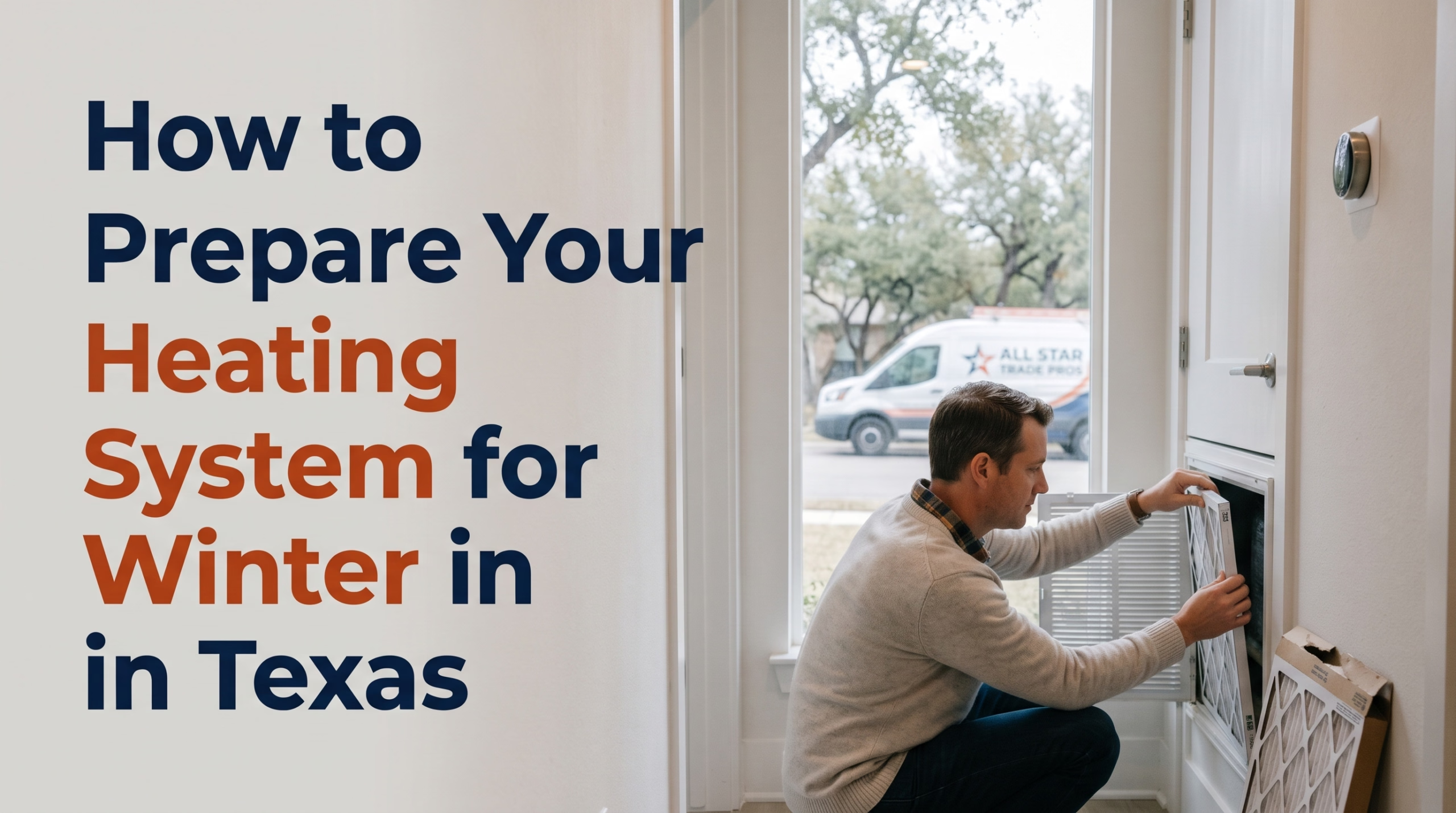
Slide the filter out and hold it up to a light. If you can’t see light through it, replace it. ENERGY STAR recommends checking your filter monthly during heavy-use seasons. It’s a cheap fix. HomeAdvisor lists furnace filters at $1 to $35.
While you’re there, make sure the supply vents and return grilles are open and not blocked by furniture or rugs.
Step 4: Confirm the Gas Is On
For a gas furnace, check that the supply valve near the furnace is open. When it’s open, the handle lines up with the pipe.
If your stove or water heater isn’t working either, the problem may be your gas supply and not the furnace. Contact your gas provider. In the Austin area, that’s often Texas Gas Service.
If your furnace is older and has a standing pilot light, check whether the flame is out. Your owner’s manual shows how to relight it. Follow those steps exactly, and give any built-up gas time to clear first. If the pilot won’t stay lit, the thermocouple may be worn out. That’s a small safety sensor, and replacing it is a job for a technician.
Step 5: Watch What the Furnace Does When It Tries to Start
A modern gas furnace follows a set sequence. Where it stops tells you where the trouble is.
- The thermostat calls for heat.
- The inducer fan starts to clear exhaust.
- A pressure switch confirms the vent is open.
- The igniter glows or sparks.
- The gas valve opens and the burners light.
- The flame sensor confirms the flame.
- The blower starts after a short delay.
Here’s how to read the clues:
| What you notice | Likely cause |
|---|---|
| Nothing happens at all | Power, thermostat, or control board |
| Clicking or humming, but no flame | Igniter, closed gas valve, or pressure switch |
| Igniter doesn’t glow | Cracked or failed hot-surface igniter |
| Burners light, then shut off in seconds | Dirty flame sensor |
| Blower runs, but air is cold | Burners not lighting, or a safety limit tripped |
| Furnace turns on and off repeatedly | Dirty filter, overheating, or a flame sensor problem |
Most furnaces also have a small blinking light on the control board. The blink pattern is a diagnostic code, and a chart inside the furnace door usually explains it. Write the pattern down. It will save your technician time.
Is the Flame Sensor Dirty?
A dirty flame sensor is a classic reason a furnace lights and then quits. Soot builds up on the thin metal rod and keeps it from sensing the flame. The control board then shuts off the gas for safety.
Some homeowners clean it themselves. If you’re comfortable with that, turn off the power and the gas first. Remove the sensor (usually one screw) and gently wipe it with a soft cloth or a very fine abrasive pad. If you’re not comfortable, a technician can do it fast. It’s also one of the cheaper repairs. HomeAdvisor puts flame sensor work at $150 to $250. Ask for a price before work starts.
Heater Not Turning On in Austin? Check Your System Type
Many Austin homes don’t have a gas furnace at all. They have a heat pump or an electric furnace, and the troubleshooting is a little different.
- Heat pumps can feel cooler than a gas furnace, and that’s normal. In cold weather they run a defrost cycle. It can briefly pause heating and release steam from the outdoor unit. Some frost on the outdoor coil is expected. A thick block of ice, or an outdoor unit that won’t run at all, is not.
- Auxiliary or emergency heat. Most heat pumps have electric backup heat. If the main system struggles in a hard freeze, the backup strips fill in. If your thermostat shows an “Aux” or “Emerg” light for long stretches, your bill may climb. Have it checked.
- Electric furnaces have no flame or gas. A no-heat problem there often comes down to a tripped breaker, a failed heating element, or a sequencer.
Not sure which type you have? Check the label on the indoor unit or the outdoor equipment, then look up the model number.
If you’d like help sorting it out, our team can help with heater repair in Austin.
Common Furnace Problems in Winter
These are the problems technicians see most when the first cold front hits:
- Dirty or clogged filters that restrict airflow and trip limit switches.
- Dirty flame sensors that cause short cycling.
- Failed igniters. Hot-surface igniters are fragile and wear out, often within several years.
- Thermostat problems, from dead batteries to bad wiring.
- Blower motor trouble, like noisy bearings or a motor that won’t start.
- Cracked heat exchangers. These are rare, but serious, because they can leak carbon monoxide.
- Neglected systems. A furnace that sat idle through a long hot season may fail the moment it’s asked to run.
That last one is big in Central Texas. As one local HVAC company puts it, people ignore the heater most of the year and then find out it’s struggling the moment January arrives.
What These Repairs Usually Cost
Prices vary by home and by company, so treat these as national ballparks. HomeAdvisor’s 2026 guide puts the average furnace repair at about $318, with most jobs between $133 and $505. The part that failed sets the bill.
| Part | Typical national cost range |
|---|---|
| Flame sensor | $150 to $250 |
| Ignitor | $150 to $500 |
| Thermostat | $100 to $600 |
| Control board | $200 to $600 |
| Blower motor | $150 to $2,000 |
These ranges come from HomeAdvisor’s 2026 furnace repair guide. Always get a written quote before the work begins.
Why Texas Homeowners Should Take No-Heat Seriously
Texas isn’t known for brutal cold. That’s exactly why a heating failure catches people off guard. Many homes here are built for heat first, with less insulation and weaker heating systems than homes in colder states.
February 2021 showed how bad it can get. The Texas Department of State Health Services counted 246 winter storm deaths across 77 counties. 28 of those were in Travis County. About 8% of the deaths were from carbon monoxide poisoning. HVAC contractors got flooded with calls, and Texas Gas Service warned of possible supply strain when lines froze in West Texas.
A normal cold snap is nothing like that storm. The lesson still holds. Fix heating problems early, before a hard freeze, and have a backup plan.
When to Call a Pro
Call a licensed technician when:
- The basic checks above don’t solve the problem.
- The igniter, gas valve, or control board seems to be at fault.
- The furnace keeps shutting off, locks out, or short cycles.
- You hear banging, screeching, or loud rattling.
- Your furnace is old and keeps breaking down.
In Texas, HVAC contractors must be licensed by the Texas Department of Licensing and Regulation (TDLR). You can look up a license on the TDLR website before you book. Ask for a clear quote before work starts. Also ask whether the tech carries common parts, like igniters and flame sensors, on the truck.
If your system is more than 15 years old, or the repair quote is close to the price of a new unit, ask for a repair-versus-replace comparison. See our page on furnace replacement in Austin.
What to Do While You Wait for Repairs
A no-heat night is rough, but you can stay safe and warm:
- Close doors to unused rooms and keep the warm air where you are.
- Layer clothing and blankets, and dress children and older adults warmly.
- Never use a gas oven, grill, or generator indoors for heat. They can cause carbon monoxide poisoning.
- If you use a space heater, plug it straight into a wall outlet. Keep it away from anything that can burn, and never leave it on when you’re not watching it.
- If the house gets too cold, stay with a friend or relative, or go to a warming location.
How to Avoid Furnace Problems Next Winter
- Test the heat in the fall. Run the system on the first cool day, not the first freezing night.
- Replace filters regularly. Check monthly, and swap when they look dirty.
- Schedule an annual tune-up. ENERGY STAR recommends a pre-season check of the gas connections, burner combustion, and heat exchanger.
- Keep the area around the furnace clear. Don’t store boxes or chemicals next to it.
- Test your CO alarms and replace the batteries.
Our heating maintenance plans make this easier to stay on top of.
Frequently Asked Questions
Why is my furnace not turning on?
The usual suspects are thermostat settings, a tripped breaker or a switched-off furnace switch, a clogged air filter, a closed gas valve, a failed igniter, or a dirty flame sensor.
Why is my heater blowing cold air?
The burners may not be lighting. Or the furnace may have shut down on a safety limit because of a dirty filter or blocked airflow. If you have a heat pump, it may be in defrost mode, which should only last a short time.
Why does my furnace turn on and then shut off?
That’s called short cycling. A dirty flame sensor and a clogged filter are the two most common causes.
How much does it cost to fix a furnace?
Most repairs fall between about $133 and $505 nationally, with an average near $318. A flame sensor sits at the low end. A blower motor or control board costs more. Ask for a written quote first.
Can I reset my furnace myself?
You can usually reset the breaker once, or follow the reset steps in your owner’s manual. If the furnace locks out again, call a professional.
Is a blinking light on my furnace bad?
Not always. It’s a diagnostic code. Check the chart inside the furnace door and tell your technician what code you see.
Who do I call if I smell gas?
Leave the home first. Then call your gas utility or 911 from outside.
Final Thoughts
When your furnace isn’t working in Texas, go through the basics in order: thermostat, power, filter, gas. Then watch the start-up sequence for clues. Many problems turn out to be simple. But gas smells, CO alarms, and repeated lockouts always mean stop and call a licensed technician.