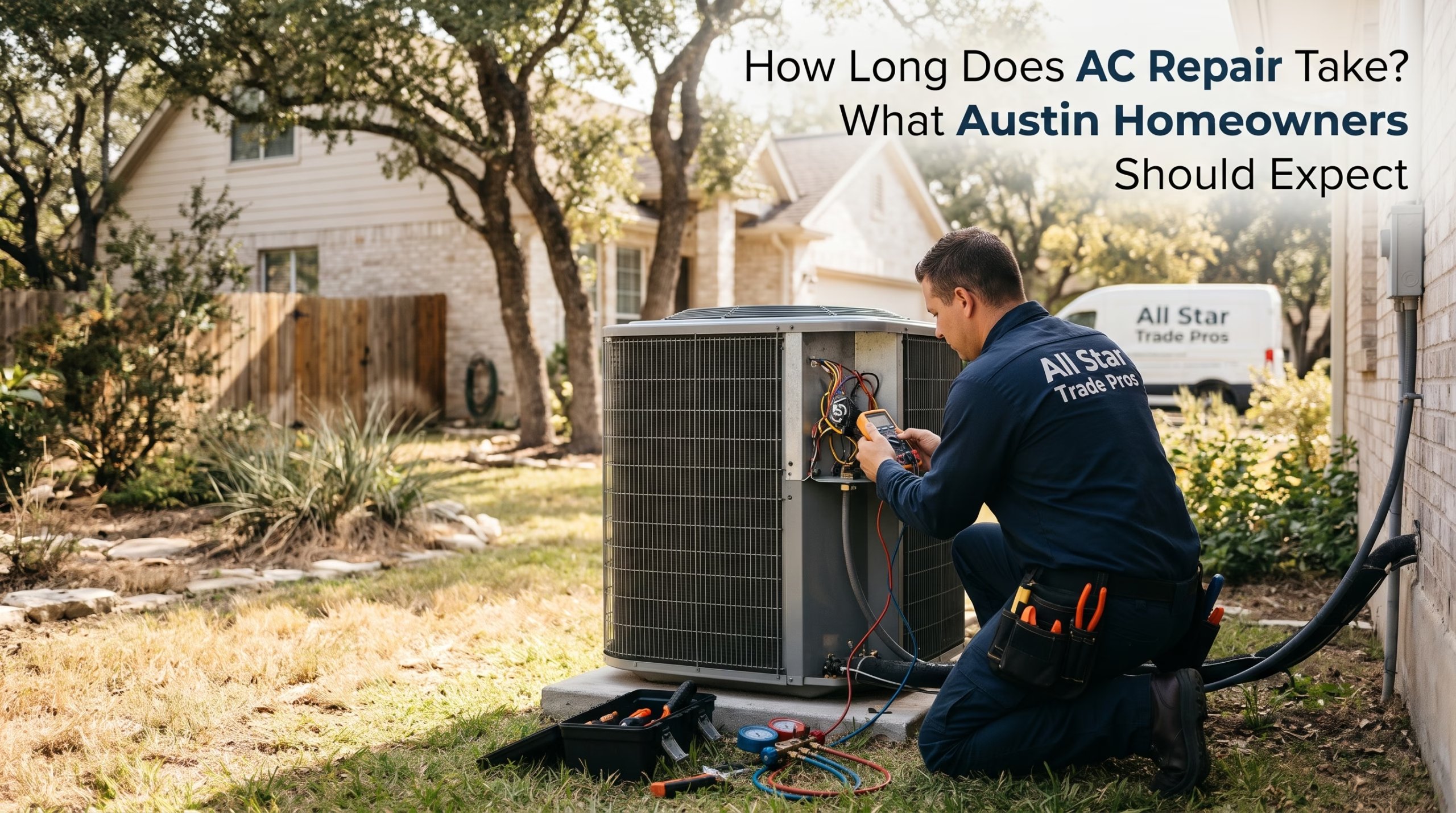
How long does AC repair take? Most repairs take one to four hours once the technician is at your house. A bad capacitor or a clogged drain line can be fixed in under an hour. Refrigerant leaks and compressor problems can take most of a day, and sometimes a second visit if a part has to be ordered.
But the work itself is only half the story. In Austin, the clock starts when you make the call. In a triple-digit heat wave, waiting for an appointment can hurt as much as the breakdown.
This guide covers both: how long common repairs take, how much they usually cost, and how long you might wait from first call to cool air.
The Short Answer: Typical AC Repair Times
Here is a quick look at what most Austin homeowners can expect on-site. These are general ranges drawn from HVAC company guides, and every home and system is different.
| Problem | Typical on-site time |
|---|---|
| Thermostat issue, clogged drain line, dirty filter or coil | 30 minutes to 1 hour |
| Capacitor or contactor replacement | 30 minutes to 3 hours |
| Fan motor replacement | 1 to 5 hours |
| Refrigerant leak repair and recharge | 2 to 8 hours |
| Compressor replacement | Several hours to a full day, sometimes a return visit |
Sources disagree a bit on the exact numbers. One Mount Pleasant, SC contractor puts a capacitor swap or thermostat fix at roughly 30 to 90 minutes. Another HVAC guide lists capacitors at one to three hours. That gap is normal. Access to the unit, the age of the system, and the technician’s experience all change the clock.
Why Diagnosis Takes Time Too
Many people picture a technician walking in, swapping a part, and leaving. Good repairs don’t work that way. First, the technician has to find out why the system failed.
Warm air can come from a bad capacitor, a thermostat problem, low refrigerant, a failing compressor, or a frozen evaporator coil from poor airflow. Each one needs to be ruled out. If a tech skips this step, you could pay for a part that was never broken.
Plan on 20 to 45 minutes for the first checks. The technician will test the electrical parts, airflow, refrigerant pressure, and the thermostat. That time pays off, because it lets them give you a firm price and a realistic timeline before any work begins.
How Long Common AC Repairs Take
Quick Fixes (Under an Hour)
These jobs go fast, and the parts are often already on the truck.
- Thermostat replacement or recalibration. Usually under an hour.
- Clogged condensate drain line. A common summer problem. Algae grows in the line and trips a shutoff switch.
- Filter and coil cleaning. Quick, and sometimes it’s all it takes to bring cool air back.
Moderate Repairs (1 to 3 Hours)
- Capacitor or contactor replacement. These small electrical parts are some of the most common reasons an AC stops running. The part itself is cheap. Most of the cost is labor, and the part often runs under $50. Many service trucks carry them, so same-day repair is realistic.
- Fan motor replacement. The condenser or blower motor can take a few hours, depending on how hard it is to reach.
- Minor electrical or wiring repairs. The time depends on how much testing is needed.
Longer Repairs (Several Hours to a Full Day)
Refrigerant leaks. This is rarely a simple top-off. Your AC runs on a sealed loop, so low refrigerant means there is a leak somewhere. The technician has to find it, repair it, pressure test the system, evacuate it, and recharge it to the exact specification. Guides from HVAC companies commonly put this at roughly 3 to 5 hours, and hard-to-find leaks or coil work push it longer.
If your system is old enough to use R-22 (often called Freon), expect added complexity. The EPA ended U.S. production and import of R-22 in 2020, so the refrigerant is scarce and costly, and a repair-or-replace conversation usually comes up.
Compressor replacement. The compressor is the heart of the system. Replacing it means recovering the refrigerant, swapping the part, and recharging the system. That can take most of a day, and if the part is not in stock, it can stretch across multiple days. On an older unit, many technicians will also talk through whether a full replacement makes more financial sense.
Evaporator or condenser coil replacement. Similar to compressor work in scope, and often involves ordering parts.
Why Your AC Repair Timeline in Austin Can Run Long
The numbers above assume the technician is already at your door. Austin’s climate changes the picture before that point.
Heat Waves Flood HVAC Companies With Calls
Austin’s official weather station is at Camp Mabry, and its records go back to the 1890s. The numbers show how hard the city’s AC systems get pushed:
- Between 1991 and 2020, Austin averaged 29 days a year at 100°F or higher.
- 2011 holds the record for most 100° days in one year, with 90.
- In 2023, Camp Mabry hit 100° or more for 45 days in a row, from July 8 to Aug. 21. The old streak record was 27 days, set in 2011.
- That July also brought 11 days in a row at 105° or higher, the longest stretch ever recorded.
- 2023 also ended up as Austin’s hottest year on record, at an average of 72.2 degrees.
When a system runs nonstop for weeks, weak parts fail. Local news from KVUE and FOX 7 Austin describes the same thing in past heat waves: record demand, full schedules, and families calling around for days. In one KVUE story, a Del Valle family called about a dozen companies. Most couldn’t come for about a week.
Parts Availability Is the Biggest Wildcard
Even when a company gets you on the schedule the same day, the part may not be on the truck. A FOX 7 Austin report quoted a local HVAC owner saying parts shortages could add a wait of two to three days. Common parts like capacitors are easy to find. Specialty motors, control boards, and compressors for certain brands are not.
Time of Day and Season Matter
A call at 8 a.m. on a mild April day is a different story than a call at 4 p.m. during the last week of August. Emergency and after-hours work often takes longer to schedule, and many companies charge extra for it.
Can You Get Same Day AC Repair in Austin?
Often, yes, with caveats. Same day AC repair in Austin is realistic when:
- You call early in the day, ideally before noon.
- The problem is a common one, like a capacitor, contactor, thermostat, or drain line.
- You are not calling during the worst week of a heat wave.
- The company stocks common parts on its trucks.
Same-day service gets harder when the fix needs a special-order part, or when every truck in town is already booked. If your AC is down and the house is heating up, ask each company two questions up front: “When is the earliest you can be here?” and “Do your trucks usually carry the parts for this kind of problem?”
What a Typical Repair Visit Looks Like, Step by Step
Knowing the flow can take some stress out of the process.
- You describe the problem. Note any noises, smells, or when the issue began.
- The technician inspects the system. This usually includes the thermostat, indoor unit, outdoor unit, and electrical connections.
- You get a diagnosis and a quote. A reputable company explains the problem and the price before starting.
- The repair happens. Time depends on the problem, as outlined above.
- The technician tests the system. Expect a check of airflow, temperatures, and refrigerant levels to confirm the fix worked.
- You get a summary. Ask what was done, whether other issues showed up, and what warranty covers the work.
How to Shorten Your AC Repair Wait
You can’t control the weather, but you can make the process faster.
- Call at the first sign of trouble. Weak airflow, odd noises, or longer run times are warning signs. Waiting for a full breakdown means joining the rush.
- Check the basics first. Make sure the thermostat is set to cool, the breaker has not tripped, and the filter isn’t clogged. Do not open the outdoor unit yourself, since capacitors can hold a dangerous charge.
- Schedule maintenance before summer. A spring tune-up lets a technician catch worn parts before peak season.
- Describe the symptoms clearly. It helps the dispatcher send the right technician with likely parts.
- Ask about parts up front. It can save you a second wait.
- Verify the license. In Texas, AC contractors must hold a license through the Texas Department of Licensing and Regulation (TDLR). You can check a license on the TDLR website before you book.
Repair or Replace? Time Can Tip the Decision
Sometimes the repair timeline is a sign the system is near the end. Replacement may be worth considering when:
- The unit is 12 to 15 years old or more.
- You are facing a compressor or coil replacement.
- The system uses R-22 refrigerant.
- Repairs are becoming frequent each summer.
Staying Safe While You Wait
Austin heat is no joke, and indoor temperatures can climb quickly when the AC is out. While you wait for repairs:
- Close blinds and curtains on sun-facing windows.
- Run fans to keep air moving.
- Drink plenty of water and avoid hard activity during the hottest hours.
- Check on children, older adults, and pets first.
- Go to a cooler place, such as a library, a friend’s home, or a city cooling center, if the house gets too hot.
Frequently Asked Questions
How long does an AC repair take on average?
Most AC repairs take one to four hours on-site. Simple repairs finish in under an hour, while refrigerant and compressor work can take most of a day.
How long does an AC diagnostic take?
A diagnostic usually takes 20 to 60 minutes, depending on the symptoms and how easy it is to reach the equipment.
Can my AC be fixed the same day?
Often, yes. Same-day repair is likely for common issues when the technician has the part on the truck. Special-order parts can push the fix back by a few days.
Why is my AC repair taking so long?
The usual reasons are a hard-to-find refrigerant leak, a part that has to be ordered, or a repair that uncovers a second problem. A good technician will explain the cause and give you an updated estimate.
How long does it take to recharge AC refrigerant?
A simple recharge may take an hour or two, but the system should not need regular recharging. If it does, there is a leak, and finding it adds time.
What is the busiest time for AC repair in Austin?
July through September, when triple-digit highs are most common. According to a 20-year average cited by KVUE, Austin’s first 100-degree day typically arrives around June 29 and the last around September 1.
Final Thoughts
So, how long does AC repair take? Plan on one to four hours for most jobs, a full day for the big ones, and extra wait time if you call in the middle of a heat wave. The best way to protect your timeline is to call early, describe the problem clearly, and ask about parts before the technician arrives.